
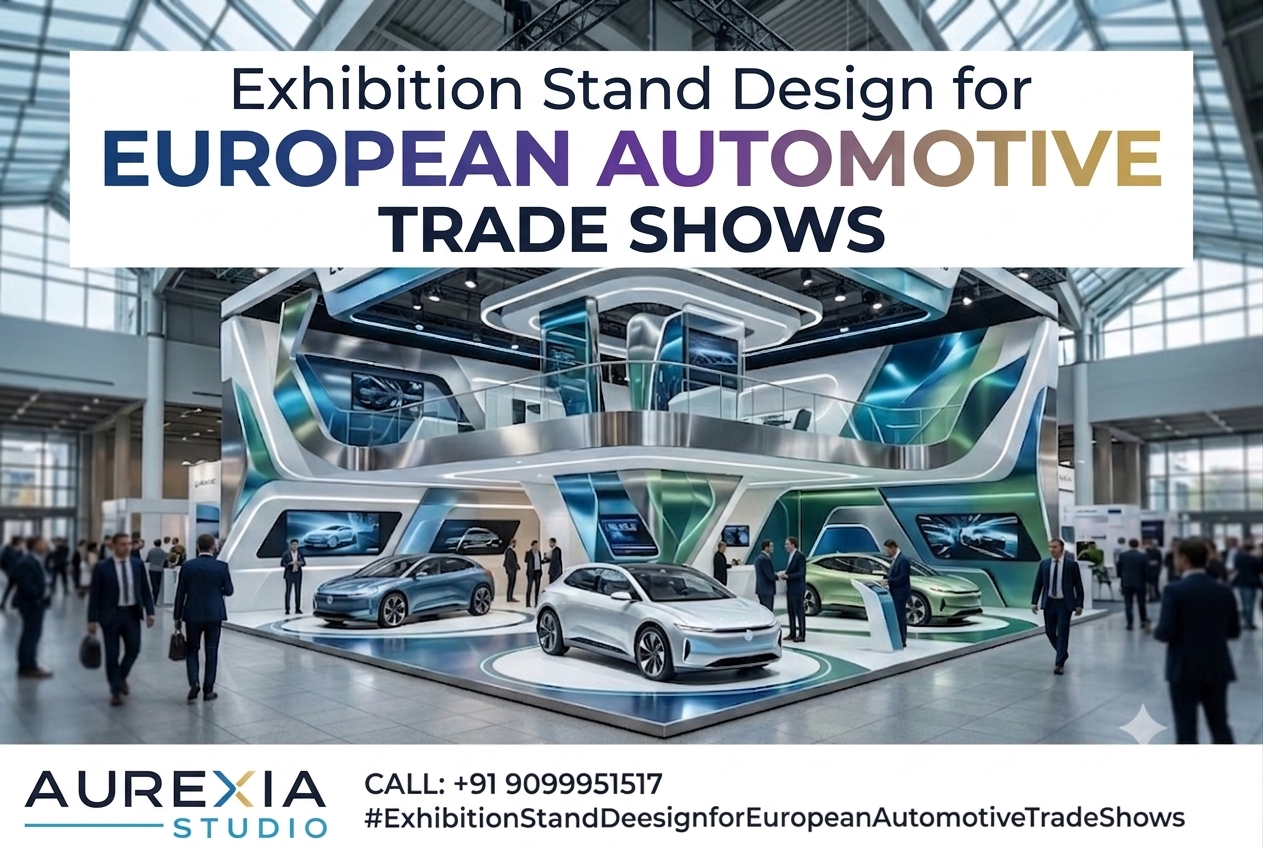
European halls are the most rule-bound exhibition environment in the world, and automotive stands attract more of those rules than most. Exhibition stand design for European automotive trade shows is therefore only half a creative exercise — the other half is knowing what the venue will and will not approve before you fall in love with a drawing.
This guide covers the operating environment: stand types, approvals, materials, contractors, and logistics. For the design and presence side — where the vehicle goes, how to light it, and what materials say about your brand — see our companion guide to exhibition booth design for automotive brands.
Start With Your Stand Type, Because It Changes Everything
European organisers classify stands by how many sides are open to an aisle. This is not administrative detail — it decides your sightlines, your entrance, and where your vehicle can sensibly sit.
Row stand
One open side
The cheapest position and the hardest to design. All your visibility comes from a single frontage, so the vehicle usually has to sit forward and the meeting space goes behind it.
Corner stand
Two open sides
A significant upgrade for a small price difference. Two frontages roughly double the approach angles, and an open corner makes the stand far easier to walk into.
Head stand
Three open sides
Strong visibility with one solid wall to build against — often the ideal balance for an automotive exhibitor: somewhere for graphics and storage, with wide access.
Island stand
Four open sides
Maximum visibility and the hardest to design well. Nothing to hide behind, so storage, services, and the back of every element must be designed as if visible — because they are.
If you have a choice, a corner or head position is usually the best value for an automotive stand. An island looks impressive and costs more than its extra square metres suggest, because everything has to be finished on all sides.
The Hall Rules That Catch Exhibitors Out
Every major European venue publishes technical guidelines. They vary by hall, but the same clauses cause the same problems every year. Read them before the concept, not after.
None of this is unusual once you have done it. It is only expensive when it is discovered late, because by then the drawings are done and the material is cut.
Vehicles, Floors, and Getting In
Automotive stands add a physical layer on top of the paperwork. Confirm all of it against your specific stand position, not the hall in general.
- Floor loading — the limit in kilograms per square metre for your position. Upper floors and basement halls are usually more restricted.
- Access route — door heights, aisle widths, ramp gradients, and turning space to get the vehicle where you want it.
- Fuel and battery rules — most venues restrict fuel levels and require batteries to be disconnected or secured. High-voltage and electric vehicles have their own requirements.
- Move-in sequence — vehicles are normally placed first and removed last, which has to match your build schedule.
- Plinths and turntables — raised or moving platforms need calculations, approval, power, and a safety assessment.
Agree the vehicle slot with the organiser as early as you agree the stand design. It is the one element you cannot improvise on site.
Official Contractors: What You Cannot Do Yourself
This surprises exhibitors arriving from markets with looser rules. In most European halls, certain work may only be carried out by the venue’s appointed contractors — typically the electrical supply connection, rigging, forklift and crane operation, and sometimes plumbing and compressed air.
Your build partner can do everything up to that connection point, but not past it. Practically, that means these items are ordered from the organiser on their deadlines and at their rates, and they need to appear in your budget from the beginning rather than as a surprise during build-up.
It also means the schedule has dependencies you do not control. If the power connection is booked for a particular morning, everything that needs power waits for it.
Sustainability Is Now a Design Requirement
European organisers increasingly ask what happens to your stand after the show, and some now set requirements rather than suggestions.
This aligns neatly with what already makes commercial sense for automotive exhibitors: a reusable structural core with changeable graphics costs less across a season and answers the sustainability question at the same time.
Cross-Border Logistics Within and Into Europe
If you are shipping from outside the EU, temporary admission documentation such as an ATA Carnet is usually the cleanest route for stand materials and display vehicles. It has to be prepared in advance and matched exactly to what physically travels.
Inside the EU, movement is simpler, but the schedule is not. Road freight into a major fair means arriving into a controlled traffic system with time slots, and missing yours can cost you a day. Build genuine contingency into the transport plan rather than optimism.
For a market-by-market view of what European stands typically cost, see our breakdown of exhibition stand costs in Germany, Poland, and Dubai.
Who Does What: A Split-Responsibility Checklist
Most European build problems come from a task nobody thought they owned. Agree this list in writing before the project starts.
Your build partner should handle
- Stand design, technical drawings, and the organiser submission
- Material fire certification and documentation on site
- Fabrication, transport, install, and dismantle
- Ordering rigging, power connection, and hall services on your behalf
- Co-ordination with hall-appointed contractors and site management
You should handle
- Space booking, position, and stand-type decision
- The vehicle or exhibit, its transport, and its documentation
- Brand assets, approved messaging, and graphic content sign-off
- Staffing, briefing, and appointment scheduling
- Customs paperwork for anything you ship yourself
One accountable partner across the first five items removes most of the risk, because the gaps between design, fabrication, and site management are where European builds usually fail. If you are exhibiting in Germany specifically, our page on working with a top exhibition stand manufacturer for trade shows in Germany explains how that works locally.
Frequently Asked Questions
How early should we start planning a European automotive stand?
Around six months for a custom build. The design work is rarely the constraint — organiser approvals, material certification, service orders, and vehicle logistics all have fixed deadlines that cannot be compressed.
Do we need approval for our stand design in Europe?
Usually yes, above a height the venue specifies and always for two-storey or covered structures. Your build partner should prepare and submit the technical package, but the deadline is real and it sits early in the schedule.
Which stand type is best for an automotive exhibitor?
A corner or head position usually gives the best value — multiple approach angles plus at least one solid wall for graphics and storage. Island stands offer the most visibility but cost more to finish, because every side is on show.
Can a non-EU company exhibit in Europe easily?
Yes, with preparation. Temporary import documentation such as an ATA Carnet, a build partner who knows the venue’s guidelines, and a realistic transport schedule handle most of the difficulty.
Why Exhibitors Choose AUREXIA Studio
At AUREXIA Studio, we design and build automotive stands for European halls, where the drawing is only accepted once the rules are satisfied. We handle the technical submission, the certification, and the co-ordination with hall contractors, so your team arrives to a finished stand rather than a problem.
Our services include:
- Custom Exhibition Stand Design
- Turnkey Booth Solutions — design, fabrication, install, and dismantle
- Exhibition Graphics & Branding
- Technical Co-ordination with Organisers and Hall Contractors
- On-Time Delivery
- One Accountable Partner from Concept to Show Day
We work across Germany, Poland, the UAE, the UK, wider Europe, and India — including at venues such as Messe Frankfurt, home of Automechanika, as well as Messe Düsseldorf and the Dubai World Trade Centre. Explore our exhibition stand design service to see how the whole chain works under one team.
Let’s Create Something Exceptional Together
From exhibition stall design and fabrication to branding, website design, and digital solutions, AUREXIA Studio helps businesses create impactful experiences across Europe, the UAE, and India.